
We’d been on the road for hours. My wife, our four kids, everybody hungry, everybody tired, all of us ready to just sit down somewhere and eat. So we found a place, got a table, and ordered. And then we waited.
Twenty minutes went by. No food. I flagged down our waitress, and she was lovely about it — “oh gosh, sorry, let me go check on that,” and she said it like she meant it. Then she disappeared. Not into the kitchen. Just… gone. Shift change? Did she leave for the day? Did she walk out and start a whole new life somewhere? Alien abduction? I have no idea. We never saw her again.
Another twenty minutes. The kids were melting. Finally a new waiter wandered over, we explained the situation, and he went to check — then came back to tell us our order had never made it to the kitchen at all or was lost. I specifically remember the first person writing down our order on a slip of paper. It had to be somewhere. Maybe stuck to another ticket. Maybe in someone’s apron pocket. Or in a pile next to the bread. For all I know, someone was happily eating it in their soup.
So I’m sitting there — hungry, a little (lot) annoyed, kids fading fast — and my first instinct was the one we all tend to default to: somebody messed up. The waitress, probably. She’s the one who vanished. Or maybe the cook. Somebody on that staff just wasn’t doing their job.
But as I think about it now, I wonder if I was wrong. Maybe that first waitress was great at her job. Maybe the cook was too. And the new waiter walked into a mess he had nothing to do with. If that was true, then what was the problem? Here’s an interesting thought… perhaps this was a system problem instead of a people problem. What was the system to get the order to the cook? Or to make sure an order didn’t get dropped? What was the system to check on waiting customers? There didn’t seem to be anything, anywhere, that said this table is still waiting.
We do this all the time, I think. Something goes sideways and we reach for a person to blame, when more often than not it’s the systems around them that quietly set everyone up to fail.
Two Things, Tangled Together
I’ve come to the conclusion there are two things sitting underneath almost any result, and most of us never really put them together or talk about them. There are probably others, of course. But these two are big, and they’re tangled up with each other in a way that’s important: the people, and the system they’re working with.
By system, I just mean the repeatable way something gets done… the structure underneath the result. We’re surrounded by them. A recipe is a system. So is the engine in our car, and the dozen other systems keeping it running. Our bodies are running a few right now without asking us. The solar system is, well, right there in the name. Some have automation baked in and some don’t, but at the core they’re all the same idea: a repeatable way that effort turns into an outcome. And a system can be wonderful or terrible — either way it’s there, whether we built it on purpose or just sort of fell into it.
By people, I mean the humans doing the work… the flesh and blood, thinking, feeling, deciding folks who showed up to get something done. For this, it helps to picture them in two loose groups. Some have both the skill and the want: they’re good at the work, through training or experience or both, and they care about doing it well. I call these the ‘Great People‘. Others are missing one or the other. Maybe there’s plenty of heart but the skill isn’t there yet. Or maybe it’s neither, and someone’s just putting in hours for a paycheck. My technical term for these peeps is the ‘Not-So-Great People‘.
Now, let’s put those two side by side — people along one axis, systems along the other — and you end up with four corners. Four places a team can land.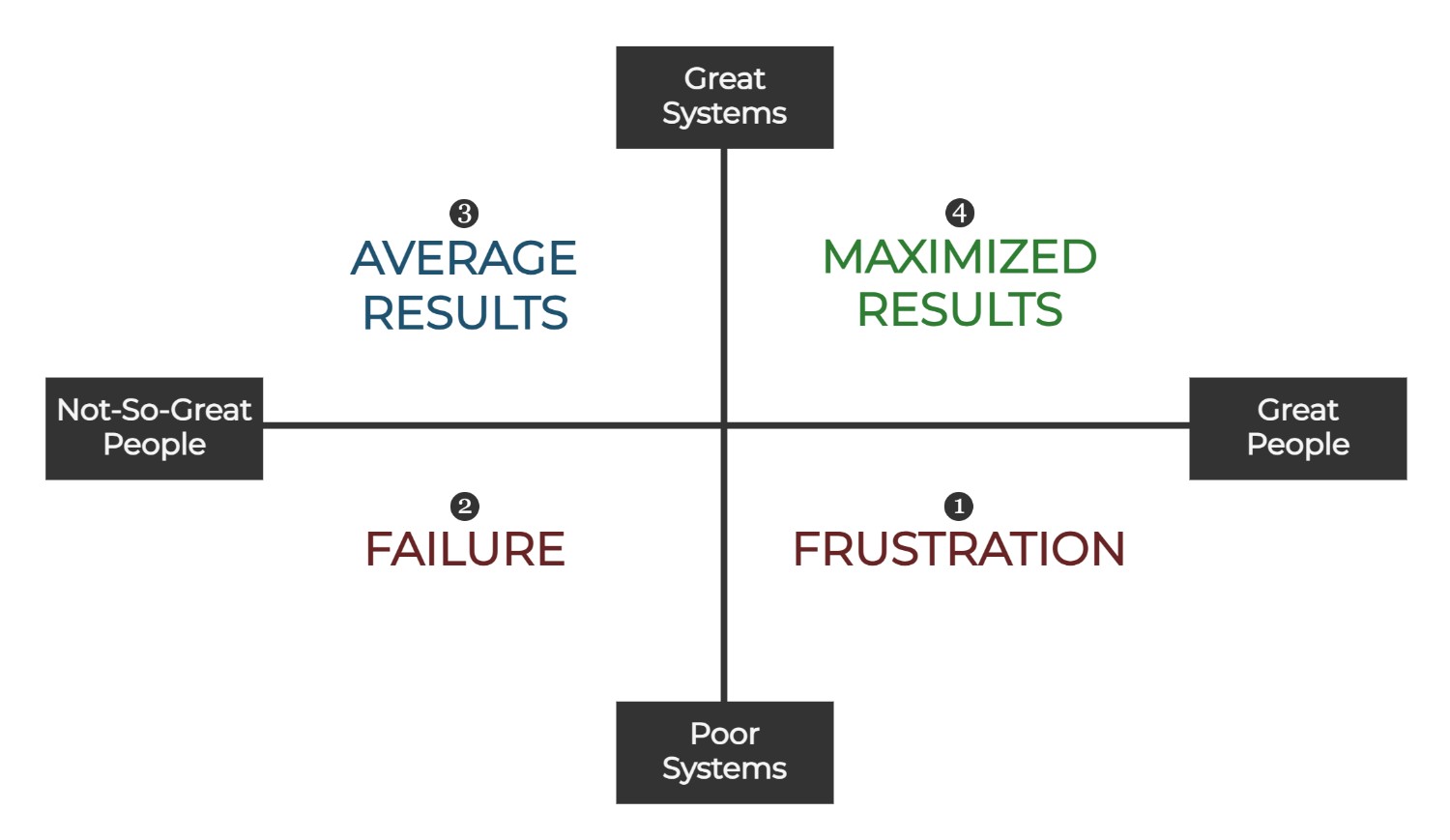
So let’s look at each of these quadrants for a moment. We’ll start in the bottom-right since it’s the corner most of us can relate to in one way or another.
1. Frustration: Great People, Poor Systems
This is where great people get stuck inside a bad system, or no system at all. Sometimes, I cringe when I hear teams boast how they like to ‘wing it’. It tends to be the corner that produces the most frustration, because the people are the right people but they’re missing the resources to empower them to do what they know to do with excellence.
W. Edwards Deming said it about as plainly as it can be said: “a bad system beats a good person every time.” To be clear, he wasn’t saying bad systems are better than good people. He was saying bad systems will ‘beat up’ a good person. Or to put it another way, broken systems break good people. It’s the broken or inefficient system that wears great people down.
Broken systems break good people.
This quietly shows up all over the place. We’ve already talked about the restaurant full of servers who care, but with no real system for getting orders to the kitchen, all heading home each day tired from apologizing or getting yelled at by customers. Or there’s the talented office team where every project somehow takes three times as long as it should and nobody can quite say why. Or a nonprofit run by people who love the mission, but the volunteer schedule is a group text and somebody’s faulty memory, so two folks show up for the same shift and the next one goes uncovered.
One thing I’ve noticed about this corner is that it’s hard to stay in for long. Something usually has to give, and it seems to go one of three ways. Sometimes the great people just burn out and leave, and things slide further to the left. Other times the team muscles out decent results through sheer effort — late nights, heroic saves, one person holding the whole thing together with sticky notes. It can look like things are working, but it’s a fragile, tiring kind of working, held up by people instead of structure, and it tends to come apart the moment someone gets tired or moves on. And every so often one of these great people actually builds the system and the team climbs straight toward the top — though I think that’s rare, maybe even unlikely, since the people stuck here are usually too overwhelmed to attempt it, or don’t have the resources or the authority to pull it off. Hint: let them!
2. Failure: Not-So-Great People, Poor Systems
This quadrant is the scary one. Most of us wouldn’t even send our own enemies here. It’s where bad systems are paired with the not-so-great people who don’t have the skill or the will. This is the corner where things tend to come apart.
There’s nothing holding anything together here. A weak system can’t keep unfocused people pointed in the right direction, and people who aren’t invested aren’t going to build a system to rescue themselves.
So the restaurant gets orders wrong, feels dirty and greasy, and the regulars eventually stop coming. The office misses one deadline after another until the clients drift away. The nonprofit’s events keep falling apart until, one season, the program just folds.
The only way out of this corner is up or sideways — someone either builds a real system, or some great people show up and pull things back into Frustration.
3. Average Results: Not-So-Great People, Great Systems
Now we cross over to the great-systems side, and this is where I think it starts to get interesting.
Take a strong system and hand it to people who aren’t all stars, and the result is… surprisingly, at least average. The system ends up carrying the weight, instead of people. It hands people the resources, the guardrails, the here’s-how-we-do-it-around-here, so even the not-so-great crew clears the bar.
Most of us have eaten at McDonald’s. This and other fast-food chains aren’t traditionally staffed by master chefs. Okay, that’s an understatement. I’m pretty sure most people who work there don’t really want to be there — and yet the fries taste about the same in Buffalo as they do in London. There is absolutely no way they could do that without solid systems. The same thing happens in an office with a well-built system for new staff: they may not have an ounce of training, but their clear checklists are enough to get things done. And the nonprofit with reliable volunteer software and clear roles makes sure every shift is covered, even if the volunteers themselves come and go.
This kind of average is steady, and it’s cheap. It holds up no matter who’s working that day. For a lot of teams this is a dangerous space. It’s tempting to stop and just let things glide. The numbers are fine, nothing’s on fire, and “fine” has a way of feeling like enough. A lot of teams settle right here and never realize there’s another gear. They forget that the optimal place to be is with great systems and great people.
That said, here’s the part about this I find kind of cool. A great system doesn’t only carry not-so-great people. Given enough time, it can grow them into great people. With some intentionality, this structure can become a training ground (clear steps, quick feedback, room to get good at the thing) and people who started as warm bodies can slowly turn into people with real skill. The system quietly makes the very thing every team seems to be short on: great people.
4. Maximized Results: Great People, Great Systems
And then there’s the top-right. Where we all want to live and work every day. Great people and great systems, working together.
This is where things start to compound. The people are skilled and they care, and the system isn’t fighting them, it’s giving them a lift. Which means they finally have something they never had down in the Frustration corner: room to breathe. They’re not pouring everything they’ve got into just holding the pieces together, so they can do the work only great people can do.
In the restaurant, that’s the kitchen running so smoothly the chef can start dreaming up specials, or maybe open a second location. In the office, it’s the team that doesn’t just use the system but keeps making it better, and pulls the newer folks up as they go. In the nonprofit, it’s the program that grows, reaches more people, and turns today’s volunteers into tomorrow’s leaders.
This is the corner we’re all reaching for — growth, room to create, a team that doesn’t feel like it’s white-knuckling its way through the week. Maximized results.
Stepping Back
OK. So that’s the whole matrix. Four corners, built around both systems and people.
A couple of things stand out to me when I look at it all together.
The first is that the two bottom corners — the ones with broken systems — carry a sneaky cost: they make everyone look bad. Just like that restaurant my family visited, we often can’t tell who the great people are, because a broken system hides them. If we can fix the system, we’ll likely find out who we had all along.
The second is the one I keep coming back to. Of the four, Frustration is the one that hurts the most. Right, you might assume Failure hurts the most… but Frustration hurts the longest. In my book, that adds up to the most. Ironically, if we’re living in quadrant one with poor systems, we already have one of the hardest, most challenging thing to find: great people. If you’ve done any hiring or recruiting, you know what I mean. What’s missing is the system, and a system is something we can build. The most painful corner, it turns out, is often the most hopeful one.
And maybe that’s the quiet thread running through all of this. Systems aren’t the point. They’re just what lets great people do the great work we all want them to do.
Great systems let great people do great work.
So Where Are You?
Alright, all of this leads to an obvious question. Which corner is your team in? Or perhaps more pointedly, which corner are you, personally, in?
Frustration Corner? Maybe it’s time to ask some tough questions about your systems before you lose more great people. Start the conversation with your team. Brainstorm ways to simplify, automate, define or reset how things get done. Perhaps even hire a consultant to help you get started.
Failure Corner? If you think you land here, it’s time to dial 911. You don’t need to pop a few Advil to deal with a headache… you need a trip to the ER and possibly emergency surgery. This isn’t a “we’ll figure it out eventually” situation. This is a “stop everything and get the right people in the room” situation. You’re missing two extremely important things: great people and great systems. Time to stop and get strategic with your leaders or other smart people.
Average Corner? Safe. Think baseball safe. The problem is, you’re on “second base safe”. You’ll need to move at some point or the other team (the competition) might still win. You’ve got the systems, at least some of them. Now you need to figure out how to turn your not-so-great people into great people. Maybe that’s a new system you need to develop. Perhaps you need to hire someone. Maybe there’s a culture issue that needs to be addressed. No matter what it is, address the elephant in the room. Average just doesn’t cut it (unless you’re McDonald’s)!
Maximized Corner? Congratulations! You have an amazing team that never wants to leave. A solid culture. Stress doesn’t rule the day, excitement and growth do. Your next step? You probably already have it laid out in your handy dandy strategic plan. Great job!
Questions about strengthening the systems and leadership behind how your team works? Drop me a line or leave a comment below.
Photo by Yan Krukau from Pexels.